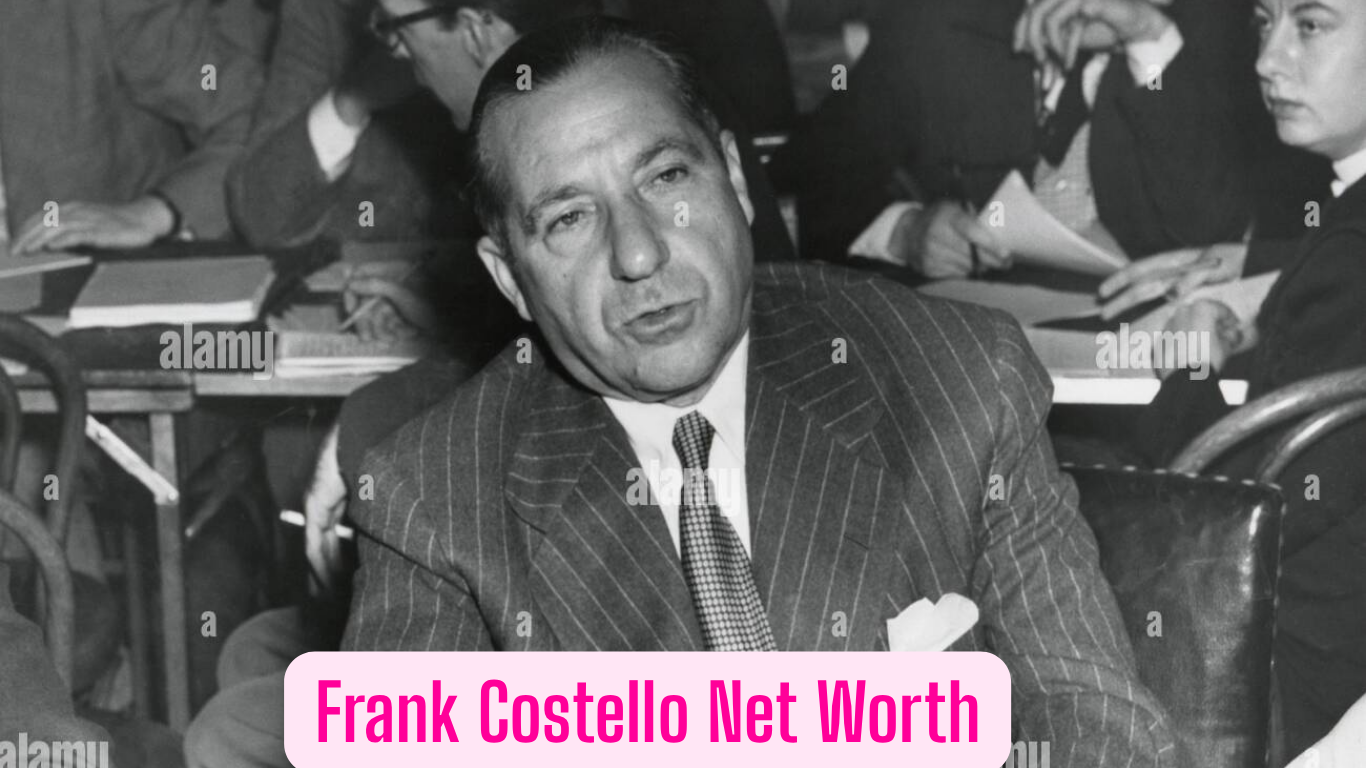
Frank Costello, known throughout his criminal career as “The Prime Minister of the Underworld,” stands as one of the most financially successful organized crime figures in American history. Unlike his more violent contemporaries, Costello built his empire through political connections, strategic alliances, and business acumen that enabled him to operate with relative impunity for decades. At the peak of his power, his criminal organization generated what would be equivalent to $60 billion in revenue in today’s economy, with his personal net worth at the time of his death in 1973 estimated to be the inflation-adjusted equivalent of $1 billion. This article explores the fascinating components of Costello’s wealth, from his early bootlegging operations to his sophisticated gambling empire and legitimate business investments.
Early Life and Criminal Beginnings
Born Francesco Castiglia on January 26, 1891, in Lauropoli, Calabria, Italy, Costello immigrated to New York City with his family at age four. Growing up in the poverty-stricken environment of East Harlem, he quickly turned to crime as a means of advancement. By age 13, he had joined a local gang and was using the name “Frankie,” committing petty crimes that led to multiple arrests for assault and robbery between 1908 and 1917. His early criminal record included a 1915 conviction for carrying a concealed weapon, which resulted in a one-year prison sentence. This experience proved formative – upon his release, Costello reportedly vowed to never carry a gun again, choosing instead to rely on negotiation and political influence rather than violence. This decision would define his approach to criminal leadership and set him apart from his contemporaries.
The Prohibition Empire: Foundation of a Fortune
The passage of Prohibition in 1920 created unprecedented opportunities for organized crime, and Costello seized them with remarkable business sense. Alongside his close associates Charlie “Lucky” Luciano, Meyer Lansky, and Benjamin “Bugsy” Siegel, Costello established massive bootlegging operations that would form the foundation of his wealth. Backed by criminal financier Arnold “the Brain” Rothstein, the gang imported liquor through New York City docks, with their largest boat capable of carrying an astonishing 20,000 cases of liquor per trip. Costello’s operations grew so sophisticated that he used seaplanes to protect his liquor shipments from hijackers. Through his partnership with Irish crime bosses Owney Madden and William “Big Bill” Dwyer in what was known as “The Combine,” Costello expanded his reach across the Eastern seaboard. When Dwyer was convicted of bribery in 1926, Costello took over his operations entirely, further consolidating his power and wealth.
Building a Gambling Empire
With the end of Prohibition in 1933, Costello strategically shifted his operations to gambling, which would become his most profitable enterprise. He controlled the slot machine and bookmaking operations for the Luciano crime family with associate Philip “Dandy Phil” Kastel. At its peak, Costello placed approximately 25,000 slot machines in bars, restaurants, drugstores, and bus stops throughout New York City. When Mayor Fiorello La Guardia cracked down on slot machines in 1934, famously confiscating and dumping thousands into the river, Costello simply moved his operations to Louisiana. There, he struck a deal with Governor Huey Long that gave Costello’s organization control over slot machines throughout the state in exchange for 10% of the profits. This arrangement brought millions in revenue to the Luciano family and demonstrated Costello’s ability to adapt and find opportunity in adversity. Beyond slot machines, Costello worked with Lansky to standardize bookmaking operations nationally and invested heavily in illegal gambling in Florida, Cuba, and later Las Vegas.
Political Connections: The Real Source of Power
What truly set Costello apart from other mob bosses was his unprecedented political influence, which protected his criminal enterprises and enabled his wealth accumulation. Costello established extensive connections with Tammany Hall leaders, New York City’s Democratic political machine. He cultivated relationships with politicians, judges, and law enforcement officials that allowed his operations to continue with minimal interference. So extensive was his influence that observers noted during the 1951 Kefauver Committee hearings that no judge reached the bench in New York without Costello’s approval during his peak years. Costello’s political power reached its height when he helped former Brooklyn judge William O’Dwyer become Mayor of New York City in 1946. During O’Dwyer’s administration, Costello’s gambling operations flourished under police protection, demonstrating his ability to manipulate city government for criminal purposes. This political protection racket proved perhaps more valuable than any specific criminal enterprise, as it provided the immunity necessary to build his billion-dollar empire.
Frank Costello Net Worth Analysis
Understanding Frank Costello’s net worth requires distinguishing between his annual revenue, total business volume, and personal wealth across different time periods:
- Peak Annual Revenue: At the height of his power, Costello’s criminal empire generated the equivalent of $60 billion annually in modern currency.
- Personal Net Worth at Death: When Costello died in 1973, his personal fortune was estimated at $1 billion in today’s dollars.
- Mid-Career Wealth: During the 1940s and 1950s, Costello amassed approximately $20 million (equivalent to over $200 million today) through his various operations.
Table: Frank Costello’s Wealth Sources Breakdown
| Wealth Source | Description | Estimated Value (Period) |
|---|---|---|
| Bootlegging Operations | Illegal alcohol distribution during Prohibition | Millions annually (1920-1933) |
| Slot Machine Empire | 25,000+ machines in NY and Louisiana operations | Multi-million dollar business (1930s-1950s) |
| Bookmaking Operations | Nationwide gambling and betting system | Primary income source (1930s-1950s) |
| Las Vegas Investments | Early casino ventures with Siegel and Lansky | Significant long-term returns (1940s+) |
| Legitimate Businesses | Meatpacking, real estate, and nightclubs | Wealth diversification and laundering |
Later Years, Legal Troubles and Retirement
The 1950s marked a turning point in Costello’s career, as he faced increasing legal pressure and internal challenges. The Kefauver Committee hearings in 1951 brought national scrutiny to organized crime, with Costello’s televised testimony making him a household name. Though only his hands were shown on camera, his nervous fidgeting and evasive answers became iconic. His defiance of the committee led to a contempt conviction and 14-month prison sentence. Further legal troubles followed, including a tax evasion conviction in 1954 that resulted in a five-year prison term, of which he served several years before the conviction was overturned on appeal. Meanwhile, internal rivalries came to a head when Vito Genovese, seeking to take control of the family, ordered Costello’s assassination. On May 2, 1957, hitman Vincent “The Chin” Gigante shot Costello in the head outside his apartment building, but Costello miraculously survived the superficial wound. Following this attempt on his life, Costello retired from active leadership of the crime family, surrendering control to Genovese, who renamed the organization the Genovese crime family. Despite retirement, Costello maintained his gambling operations and continued to be respected in underworld circles, with mob captains still seeking his advice until his death.
Legacy and Conclusion
Frank Costello died of a heart attack on February 18, 1973, at age 82. His legacy represents a unique chapter in organized crime history – that of a criminal executive who preferred boardrooms to back alleys. Unlike Al Capone’s violent reign or John Gotti’s flamboyant publicity, Costello built his empire through political manipulation and strategic alliances. His “Prime Minister” nickname reflected his diplomatic approach to criminal leadership. Costello’s life demonstrates the immense profitability of organized crime during its mid-20th century peak, while his ability to avoid significant prison time until his later years highlights the power of political corruption. The fact that his net worth reached approximately $1 billion in contemporary value places him among the most financially successful crime figures in American history, a testament to his business acumen and understanding that in criminal enterprise, political influence often proves more valuable than violence.
Disclaimer
This article is for informational and educational purposes only. The net worth figures and financial estimates presented are based on various public sources and historical records, which may contain discrepancies. These values should be considered approximations rather than definitive financial statements. The author and publisher do not endorse or glorify criminal activities and are not responsible for any misinterpretation of the content. All financial information is provided as-is without warranty of accuracy.
FAQs
1. How much was Frank Costello worth when he died, and what is that in today’s money?
When Frank Costello died in 1973, his personal fortune was estimated to be worth the equivalent of approximately $1 billion in today’s money. This massive wealth was accumulated through his various criminal enterprises, including bootlegging during Prohibition, a nationwide slot machine empire, bookmaking operations, and strategic investments in both illegal and legitimate businesses over his five-decade-long career.
2. Why was Frank Costello called “The Prime Minister of the Underworld”?
Costello earned the nickname “The Prime Minister of the Underworld” because of his unique, non-confrontational leadership style. Unlike other mob bosses who ruled through violence and intimidation, Costello preferred to use his extensive political connections, negotiation skills, and strategic alliances to resolve disputes and protect his business interests. His ability to influence politicians and judges was considered his true power, much like a political leader.
3. What happened to Frank Costello’s money and empire after he retired?
After surviving an assassination attempt in 1957 and facing increasing legal pressure, Costello officially retired and ceded control of his crime family to Vito Genovese. However, he retained control of his most lucrative and low-profile assets, particularly his gambling and bookmaking operations. He lived comfortably off this wealth until his death in 1973. The broader criminal empire he helped build was absorbed by the Genovese crime family, which remains one of the most powerful Mafia organizations in the U.S.
4. How did Frank Costello make most of his money?
Costello built his fortune through several key ventures:
- Prohibition Bootlegging: This was the initial foundation of his wealth, involving the large-scale smuggling and distribution of illegal alcohol.
- Gambling Empire: This was his most profitable long-term venture, featuring a network of an estimated 25,000 slot machines and a national bookmaking operation.
- Political Protection: His influence over politicians and judges wasn’t a direct revenue stream but was essential for protecting his other enterprises from law enforcement, allowing them to flourish.
5. Did Frank Costello have any legitimate businesses?
Yes, like many sophisticated mobsters of his era, Costello invested in legitimate businesses to diversify his income and launder his illegal profits. His known legitimate ventures included investments in real estate, the meatpacking industry, and nightclubs. These businesses provided him with a legal source of income and helped conceal the true source of his wealth from authorities.