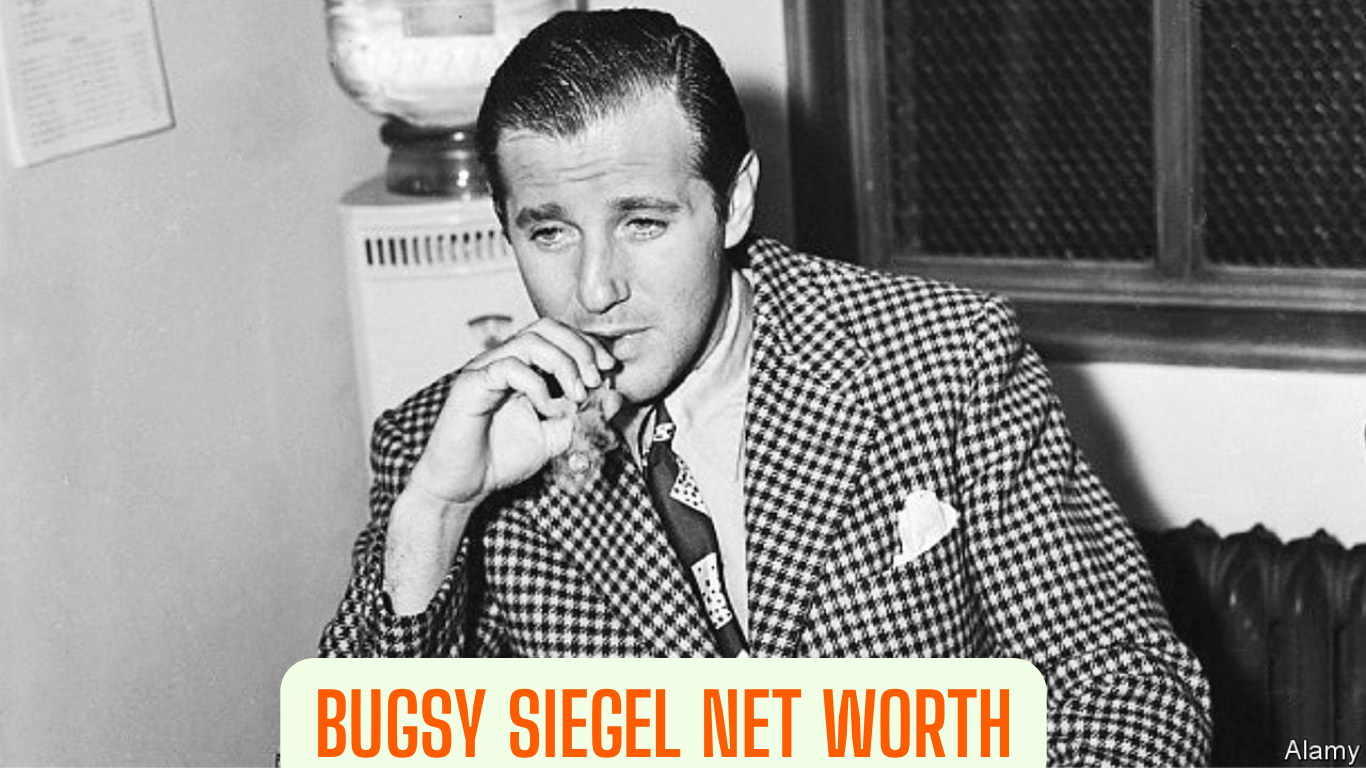
Benjamin “Bugsy” Siegel stands as one of the most iconic and enigmatic figures in American criminal history. More than just a mobster, Siegel was a visionary who saw the potential for a glittering oasis in the Nevada desert, ultimately paving the way for modern Las Vegas. His life was a paradox of brutal violence and refined ambition, culminating in a legacy far more valuable than his actual net worth at the time of his death. While his estate was valued at a fraction of his empire’s potential, his true financial impact is measured in the billions of dollars generated by the city he helped create.
This article delves deep into the complex finances of Bugsy Siegel, separating the myth from the reality of his wealth, exploring the sources of his income, and revealing the staggering cost of his ultimate vision.
Who Was Bugsy Siegel? From Street Thug to Criminal Aristocrat
Born Benjamin Siegelbaum in 1906 in Brooklyn, New York, Siegel’s journey into crime began on the streets. He formed a lifelong partnership with Meyer Lansky, and their gang, known as the “Bugs and Meyer Mob,” evolved from simple protection rackets into a sophisticated organization involved in bootlegging, gambling, and contract murder. It was during this violent early career that he earned the nickname “Bugsy” for his volatile, “bugs” temper.
Siegel, however, detested the moniker. He aspired to be more than a street-level thug. With his movie-star looks, charisma, and taste for the finer things, he cultivated an image of a sophisticated businessman and playboy. This ambition led him to relocate to the West Coast in the late 1930s, where he was tasked by the East Coast Syndicate to develop their criminal interests in California and Mexico. In Los Angeles, he seamlessly infiltrated Hollywood’s elite circles, leveraging his connections for profit and influence.
The Flamingo: A $6 Million Gamble That Cost Him Everything
While Siegel’s bootlegging, drug trafficking, and extortion rackets made him a wealthy man, his fortune is inextricably linked to the Flamingo Hotel and Casino. The project was not originally his idea; it was conceived by Billy Wilkerson, owner of the Hollywood Reporter. However, seeing its potential, Siegel used mob funds—loaned through the Teamsters’ pension fund—to muscle in and take over.
The Flamingo was Siegel’s grand vision. He imagined a luxurious, world-class resort that would attract Hollywood’s A-list and high-rollers from across the country, a stark contrast to the cowboy-themed casinos that dotted the Las Vegas strip at the time. However, his ambition knew no bounds, and the costs spiraled out of control.
- Construction Woes: Building materials were scarce and expensive post-World War II.
- Siegel’s Extravagance: He insisted on the most luxurious materials, from imported Italian marble to the finest furnishings, and siphoned off a significant amount of money for his own lavish lifestyle.
- Mob Skimming: Other syndicate members were also helping themselves to the construction fund.
The initial budget was around $1.2 million. By the time the Flamingo opened in December 1946, the cost had ballooned to over $6 million (equivalent to over $85 million today). The grand opening was a disaster; bad weather kept celebrities away, and the casino lost money. When it was forced to temporarily close, Siegel’s fate was sealed. His partners in the East, including Meyer Lansky, concluded that he had either mismanaged their investment or, worse, was stealing from them. On June 20, 1947, while sitting in his girlfriend Virginia Hill’s Beverly Hills mansion, Bugsy Siegel was assassinated, struck by multiple rifle shots through the window.
Bugsy Siegel’s Net Worth at Death: The $100,000 Reality
Despite his lavish lifestyle and control of a multi-million dollar project, Bugsy Siegel’s personal net worth at the time of his death was surprisingly modest. Official records and credible historical accounts estimate his liquid assets and personal property to be worth approximately $100,000 at the time of his death. This is equivalent to roughly $1.3 million in today’s money.
This figure seems shockingly low for a man of his stature for several key reasons:
- The Flamingo Was Not His: The Flamingo was built with syndicate money. Siegel may have controlled it, but he did not own it outright. His personal fortune was not tied to the casino’s equity.
- High-Rolling Lifestyle: Siegel lived an extraordinarily expensive life. He maintained multiple homes, wore custom-tailored suits, drove luxury cars, and was a constant presence in Hollywood’s most exclusive circles. His spending consistently outpaced his criminal income.
- Siphoning Funds: It is widely believed that Siegel was embezzling from the Flamingo’s construction budget to fund his lifestyle, meaning the mob’s money was his primary source of income at the end of his life.
- Asset Seizure and Hidden Wealth: Like many mobsters, Siegel likely had money stashed in hidden accounts or invested in legitimate front businesses, making a full accounting of his wealth impossible.
The Legacy Worth Billions: Siegel’s True “Net Worth”
If we measure net worth not just in cash but in lasting impact, Bugsy Siegel’s fortune is incalculable. His true “wealth” lies in his vision.
- The Architect of Modern Las Vegas: Before Siegel, Las Vegas was a dusty stopover for railroad workers and a few small casinos. The Flamingo, with its luxury, glamour, and high-class entertainment, set the template for every mega-resort that followed. He transformed a desert town into a global destination.
- A Blueprint for Billions: The entire Las Vegas Strip, which now generates tens of billions of dollars in annual revenue, operates on the model Siegel pioneered. Every resort from the Bellagio to the Wynn owes a conceptual debt to his original idea.
In this sense, while Siegel died with a net worth of $100,000, his vision created an economic engine worth hundreds of billions of dollars.
Conclusion: A Fortune of Vision, Not Currency
Bugsy Siegel’s story is a classic tale of American ambition, riddled with violence, glamour, and ultimately, tragedy. His personal net worth of approximately $100,000 at the time of his death paints a picture of a man who was cash-poor but vision-rich. He poured every resource, including his life, into a dream that was too big and too expensive for his time. He died not as a wealthy man, but as the catalyst for one of the greatest wealth-generating industries in modern history. His financial legacy is a paradox: a man who died nearly broke but whose idea built a city of unimaginable riches.
Disclaimer
This article is for informational and educational purposes only. The net worth figures and financial estimates presented are based on data drawn from public sources, historical records, and biographies, which may contain discrepancies. These values should be considered approximations rather than definitive financial statements. The author and publisher do not endorse or glorify the criminal activities described herein and are not responsible for any misinterpretation of the content. All information is provided as-is without warranty of accuracy.
FAQs
1. How much was Bugsy Siegel worth when he died?
At the time of his assassination in 1947, Bugsy Siegel’s personal net worth was approximately $100,000. When adjusted for inflation, this is equivalent to about $1.3 million in today’s money. This figure is surprisingly modest given his lavish lifestyle and control of the multi-million dollar Flamingo project, largely because the casino was funded with syndicate money, not his own.
2. If he built the Flamingo, why wasn’t Bugsy Siegel richer?
The Flamingo Hotel and Casino was not Siegel’s personal asset; it was financed with an estimated $6 million from the East Coast crime syndicate. Siegel was the project’s visionary and manager, but he did not own it outright. His personal fortune was separate from the casino’s massive construction budget, much of which was lost to his extravagant spending and alleged embezzlement.
3. What was Bugsy Siegel’s biggest financial legacy?
Siegel’s true financial legacy is not his personal bank account but his role as the architect of modern Las Vegas. His vision for the Flamingo as a luxurious, world-class resort set the blueprint for the entire Las Vegas Strip. The hundreds of billions of dollars in revenue generated by the city’s casino industry all trace their conceptual origins back to his ambitious, if flawed, initial project.
4. How did Bugsy Siegel make most of his money?
Before the Flamingo, Siegel’s wealth came from a portfolio of criminal enterprises. With his partner Meyer Lansky, he profited from bootlegging during Prohibition, drug trafficking, illegal gambling operations, and extortion. After moving to Los Angeles, he expanded his rackets and used his Hollywood connections for various profitable, often illicit, ventures.
5. Why was Bugsy Siegel killed if the Flamingo was a good idea?
Siegel was assassinated because his syndicate partners lost faith in him. The Flamingo’s cost had ballooned from $1.2 million to over $6 million, and its disastrous initial opening led to massive losses. The syndicate, including Meyer Lansky, believed Siegel was either dangerously incompetent or was stealing from them. His murder on June 20, 1947, was a direct result of this financial mismanagement and the mob’s desire to protect their investment.