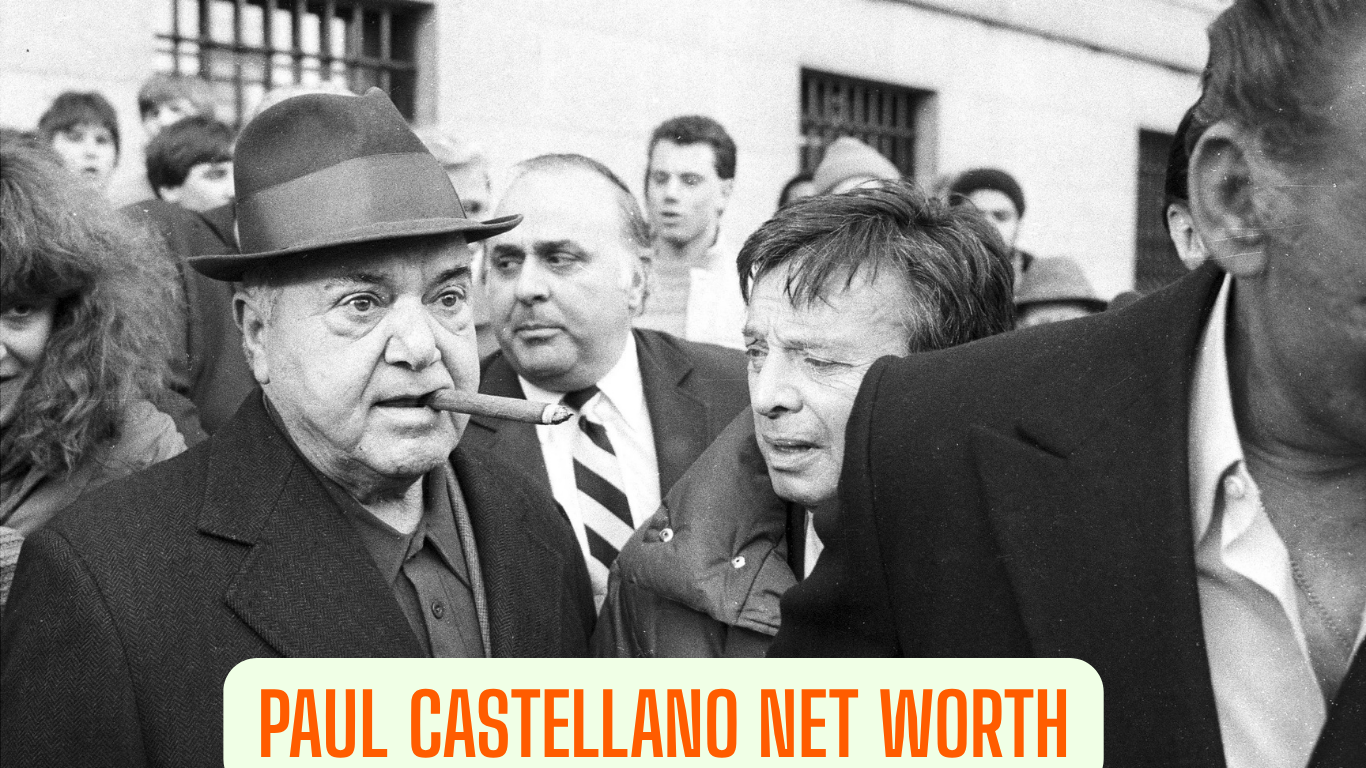
Paul Castellano, known throughout the underworld as “Big Paulie” and “The Howard Hughes of the Mob,” was one of the most powerful and wealthy American Mafia bosses of the 20th century . At the peak of his power in the early 1980s, his net worth was estimated to be $20 million, a fortune equivalent to approximately $50 million in today’s currency . As the head of the formidable Gambino crime family, Castellano revolutionized organized crime by focusing on white-collar criminal enterprises and legitimate business infiltration, amassing incredible wealth while living an increasingly reclusive life that would ultimately contribute to his dramatic downfall.
This article delves deep into the complex financial empire of Paul Castellano, exploring the legitimate and illicit ventures that built his fortune, the lavish lifestyle it supported, and the internal family tensions that led to his infamous assassination on the streets of New York City.
Early Life and Criminal Beginnings
Constantino Paul Castellano was born on June 26, 1915, in Brooklyn, New York, to Sicilian immigrant parents . His father, Giuseppe Castellano, was both a butcher and an early member of what would later become the Gambino crime family, providing young Paul with an early introduction to both legitimate business and criminal enterprise . Castellano dropped out of school after eighth grade to work in his father’s butcher shop and learn the trade that would later form the foundation of his criminal empire .
His formal entry into the criminal world began in 1934 when the 19-year-old Castellano was arrested for robbing a haberdasher in Hartford, Connecticut . He served three months in prison but refused to identify his accomplices to police, significantly enhancing his reputation for mob loyalty and adhering to the code of omertà . This early demonstration of fidelity to criminal principles would prove crucial to his later rise through the ranks of organized crime.
Castellano’s familial connections strengthened considerably when his sister, Catherine, married their cousin Carlo Gambino in 1932 . This dual relationship—both blood and marital—forged an powerful alliance that would eventually propel Castellano to the pinnacle of organized crime in America .
Building a Criminal Empire: The Path to $20 Million
Rise to Power and Business Ventures
Paul Castellano’s ascent to the top of the Gambino crime family was methodical and strategic. He became a caporegime (captain) under boss Albert Anastasia and was among the 61 high-ranking mobsters arrested at the infamous Apalachin meeting in 1957, which brought national attention to organized crime in America .
When Carlo Gambino died of natural causes in 1976, he surprisingly appointed Castellano as his successor over his underboss, Aniello Dellacroce . This decision effectively split the Gambino family into two factions—Dellacroce’s traditional street criminals in Manhattan and Castellano’s more business-oriented faction in Brooklyn .
Unlike many of his contemporaries, Castellano identified more as a businessman than a traditional criminal . His business empire was built on two primary pillars:
- Meat Distribution: Drawing on his early training as a butcher, Castellano launched Dial Poultry, a distribution business that supplied 300 butchers throughout New York City . He used strong-arm tactics to force supermarket chains like Key Food and Waldbaum’s to carry his products, effectively creating a monopoly through intimidation .
- Construction Concrete: Castellano handled the Gambino family’s interests in the “Concrete Club,” a selective group of contractors chosen by The Commission (the mob’s ruling body) to handle major construction projects in New York . These contractors were required to provide a 2% kickback on all contracts, generating massive revenue for the crime family . His son Philip served as president of Scara-Mix Concrete Corporation, which maintained a near-monopoly on concrete supply in Staten Island .
Wealth and Lavish Lifestyle
At the height of his power, Castellano’s criminal enterprise was generating staggering income. According to Sammy “The Bull” Gravano, mob bosses like Castellano and his successor John Gotti typically earned between $10-15 million per year . This immense wealth funded an extraordinarily opulent lifestyle that would eventually create resentment within the Gambino family.
In 1981, Castellano spent over $1 million to construct an extravagant 17-room mansion on Staten Island that became known as “The White House” due to its resemblance to the presidential residence . The property featured:
- An Olympic-sized swimming pool
- Elaborate English gardens
- Top-of-the-line Carrara marble throughout the interior
- Extreme security measures and luxury furnishings
As his wealth grew, Castellano became increasingly isolated, rarely venturing outside his mansion and requiring his captains to visit him there to deliver information and receive orders . He began wearing satin and silk dressing gowns with velvet slippers around the house, further distancing himself from the street-level criminals who formed the foundation of his organization .
The Downfall: Seeds of Destruction
Internal Family Conflict
Castellano’s lavish lifestyle and business decisions created growing resentment within the Gambino family. To fund his extravagant spending, he increased the monthly tribute (kickbacks) he demanded from his captains from the traditional 10% to 15%, creating financial strain for many of them .
John Gotti, a protégé of underboss Aniello Dellacroce, emerged as the leader of the opposition faction. Gotti viewed Castellano as greedy, isolated, and lacking street credibility . Their conflict intensified due to:
- Disputes over profit sharing from hijackings at John F. Kennedy International Airport
- Gotti’s suspected involvement in drug trafficking, which Castellano had banned under threat of death due to the severe legal penalties
- Personal dislike for Castellano’s reclusive behavior and perceived arrogance
Legal Troubles and assassination
The final years of Castellano’s life were marked by increasing legal pressure. In 1983, the FBI successfully planted listening devices in his mansion, providing law enforcement with unprecedented access to the inner workings of the Gambino family . In March 1984, he was indicted on federal racketeering charges including murder, extortion, narcotics trafficking, and prostitution .
On December 16, 1985, just two weeks after the death of underboss Aniello Dellacroce, Castellano was driven to a prearranged meeting at Sparks Steak House in Midtown Manhattan . As he exited his vehicle, a hit team approached and shot him multiple times, killing him instantly . John Gotti observed the assassination from a parked car across the street and subsequently assumed leadership of the Gambino family .
Comparative Wealth of Notorious Criminals
To understand Paul Castellano’s financial standing within the criminal underworld, the table below compares his wealth to other infamous figures:
Legacy and Conclusion
Paul Castellano’s legacy represents a pivotal transition in American organized crime history. His $20 million fortune, built through a combination of brutal criminal tactics and sophisticated business infiltration, marked the peak of traditional Mafia power before the more volatile, media-centric era of John Gotti.
The very wealth that established his power—the extravagant mansion, the demand for higher tributes, and his isolation from street-level operations—ultimately sowed the seeds of his destruction . His 1985 assassination, orchestrated by his own protégé, signaled the end of the relatively stable “boss of bosses” era and ushered in a period of instability and increased law enforcement scrutiny that would ultimately weaken the American Mafia .
While later criminals would amass larger fortunes through drug trafficking and other enterprises, Paul Castellano remains one of the most significant figures in organized crime history—a man whose financial success and business acumen revolutionized criminal enterprise, yet whose personal ambitions and isolation led to his dramatic downfall on a New York City street in 1985.
Disclaimer
This article is for informational and educational purposes only. The net worth figures and financial estimates presented are based on data drawn from public sources and may contain discrepancies. These values should be considered approximations rather than definitive financial statements. The author and publisher do not endorse or glorify the criminal activities described herein and are not responsible for any misinterpretation of the content. All financial information is provided as-is without warranty of accuracy.
FAQs
1. How did Paul Castellano make most of his money?
Paul Castellano built his $20 million fortune through a mix of illicit rackets and strategic legitimate business infiltration. His two biggest revenue streams were his control over the meat distribution industry through Dial Poultry, which used strong-arm tactics to monopolize supplies to supermarkets, and his dominance in the construction industry via the “Concrete Club,” which demanded a 2% kickback on all major New York City construction projects.
2. Why was Paul Castellano called the “Howard Hughes of the Mob”?
He earned the nickname due to his increasingly reclusive and isolated lifestyle. In his later years, Castellano rarely left his opulent 17-room Staten Island mansion, conducting all mob business from within its walls. He was known to wear silk dressing gowns and velvet slippers, deliberately distancing himself from the street-level operations and gritty image of his underlings, much like the famously eccentric and secluded billionaire Howard Hughes.
3. What was the main reason John Gotti had Paul Castellano killed?
The assassination was the result of multiple escalating tensions. The primary reasons were Gotti’s resentment over Castellano’s greed and isolation, Castellano’s decision to increase the monthly tribute (kickbacks) from his captains, and the imminent threat of Castellano discovering Gotti’s involvement in drug trafficking—a violation of a core family rule. Gotti also feared Castellano would have him killed for this insubordination and moved first to seize power.
4. How did Paul Castellano’s net worth compare to other mob bosses?
With an estimated net worth of $20 million (about $50 million today), Castellano was incredibly wealthy, but not the richest. His predecessor and brother-in-law, Carlo Gambino, was wealthier with an estate valued at $86.3 million. However, Castellano’s fortune far surpassed that of his underboss, Aniello Dellacroce, and his successor, John Gotti, whose net worth was estimated at $30 million.
5. Was Paul Castellano’s wealth primarily from legitimate businesses?
While he used legitimate fronts like Dial Poultry and Scara-Mix Concrete, the wealth generated was fundamentally illicit. These businesses operated as monopolies enforced through violence, extortion, and intimidation. The profits were the result of racketeering, not fair market competition. The legitimate businesses served to launder money and provide a cover for the criminal enterprise that was his true source of power and income.